“Should we build it on WordPress or have it custom built?” is one of the first questions we are asked, and it is often the wrong question, because the two are not opposites. A WordPress site can be custom designed and coded, and a “custom” site can be a bought template with the labels changed. What people usually mean is: should we use a ready-made theme on a content management system, or should we have something designed and built specifically for us? That is a real decision, and this guide sets out how to make it.
The three things people mean by “custom”
Before comparing, it helps to separate three different setups, because the trade-offs are different for each.
- A theme on WordPress. A bought or free theme, often with a page builder such as Elementor, customised with your colours, logo and content. Cheapest and quickest. The layout is the theme’s, not yours.
- A custom WordPress build. The site is designed from a blank page, then a theme is written for that design. You get WordPress’s editing, plugins and ecosystem with a site that looks like nothing else. This is how we build.
- A fully custom application. No WordPress at all: the site or product is written in a framework such as Laravel, Node or React with its own database. Right for software products, portals and anything WordPress would get in the way of.
Most of the arguments online compare the first with the third and ignore the second, which is where most businesses should end up.
Cost
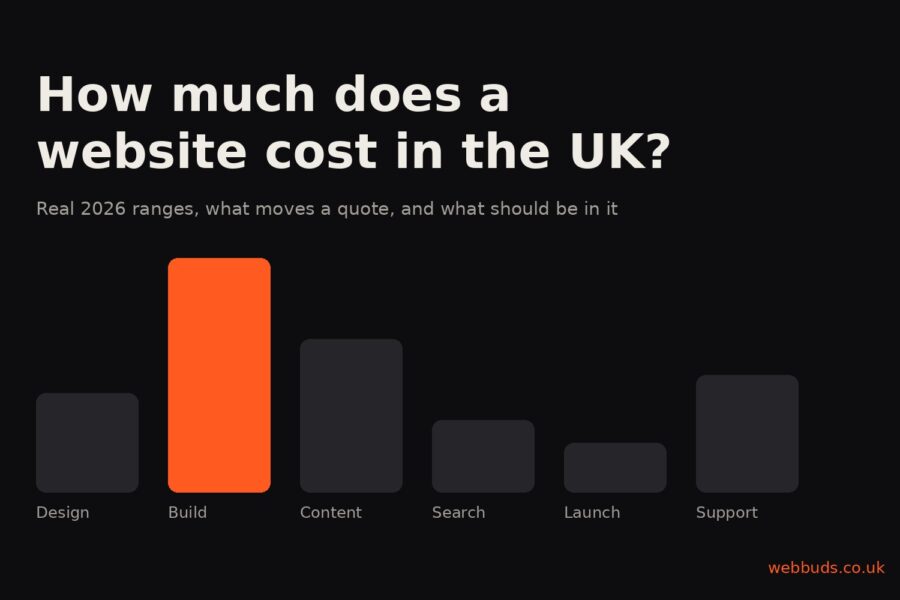
A theme site costs the least to build: £1,500 to £5,000 from a freelancer in London is typical. A custom WordPress build runs £5,000 to £20,000 for a brochure or content site and more for ecommerce. A custom application starts around £20,000 and has no ceiling.
The cost to run them is the other way round. Theme sites tend to accumulate plugins, each of which needs updating and each of which can break the others. Custom builds have less in them, so there is less to go wrong. Custom applications need a developer for every change, which is fine if you have one and expensive if you do not.
Speed
A theme built to suit everyone carries code for everything, and page builders add more. It is common for a theme site to load a megabyte of script before it shows anything. A custom theme loads what that page needs. In practice, a well-built custom WordPress site scores in the nineties on Google’s mobile performance test, and a theme-and-builder site struggles to pass. Custom applications can be as fast as the developer makes them.
Search rankings
Google does not care which platform you use. It cares whether the page is fast, readable, well structured and answers the search. WordPress makes the mechanics easy: titles, descriptions, sitemaps and structured data are handled by plugins or the theme. A custom application has to have all of that written for it, and it is often forgotten. A theme site has the mechanics but is usually slow, which does count against it. On balance a custom WordPress build is the easiest of the three to rank, because the structure is right and the speed is good.
Security
WordPress is attacked more than any other platform because it is used more than any other platform. Almost every successful attack goes through an outdated plugin or a weak password, not WordPress itself. A theme site with forty plugins has forty doors to keep locked. A custom build with eight has eight. A custom application has none of the WordPress attack surface, but it also has none of the WordPress security community, so its security depends entirely on who wrote it.
Who can edit it
This is where theme sites and custom WordPress builds differ most in practice. With a page builder, your team can change anything, which sounds good until someone drags a column out of place and the homepage breaks on phones. With a custom build done well, the layout is fixed and the content is editable: every word, image and link in plain fields, with no way to break the design. A custom application usually needs a developer for content changes unless an admin area has been built, which costs more.
Flexibility
Need a new section next year? On a theme site you add it with the builder and hope it matches. On a custom WordPress build the developer adds a block, usually in a day. On a custom application it depends entirely on how the application was written. WordPress’s real advantage here is the ecosystem: payment providers, mailing lists, booking systems and CRMs all have ready-made connections. Custom applications have to build each one.
When a theme is the right answer
- You need a site next week and the budget is under £3,000.
- The business is new and may change direction before the site matters.
- Nobody will ever compare your site with a competitor’s before deciding to buy.
When a custom WordPress build is the right answer
- The website is how you win work, and the people deciding will look at it.
- Your team needs to edit content without a developer, but without being able to break it.
- You sell online, take bookings or publish regularly.
- You want a site that still looks like yours in five years.
When a custom application is the right answer
- The product is software: a portal, a dashboard, a marketplace, a tool people log into every day.
- WordPress would be the slowest part of the system.
- Data, permissions and workflows are more important than pages.
Many businesses end up with two things: a custom WordPress site for the public and a custom application behind a login. We built exactly that for Whitehall Property Management, with a marketing site in WordPress and a React portal that replaced their legacy system.
Can you move from one to the other later?
Yes, and it happens often. Theme sites get rebuilt as custom WordPress sites when the business outgrows them, usually within two or three years; the content moves across and the old addresses redirect so rankings carry over. Custom WordPress sites get a custom application added beside them when a product or portal is needed. Going the other way, from custom to a theme, almost never happens, which tells you something.
Our view
For nearly every business website, shop or content site, a custom WordPress build is the right balance: original design, fast pages, an editing system your team can use, and a platform with more developers than any other, so you are never locked in to us. We build that way at Web Buds, and when the job is a portal or a product we build it as an application instead; see SaaS and portal development. If you are weighing it up for a particular site, describe it to us and we will tell you which of the three it needs, even when the answer is the cheap one.